Vacation Foundry Tour

On the way to Colonial Williamsburg for a family vacation this past memorial day weekend, my family and I “just happened to” be passing right by our friends at the foundry that’s making a big custom order of lanterns for Remains. My wife and children viewed this coincidence with narrowed eyes and a surprising lack of enthusiasm. What the heck?

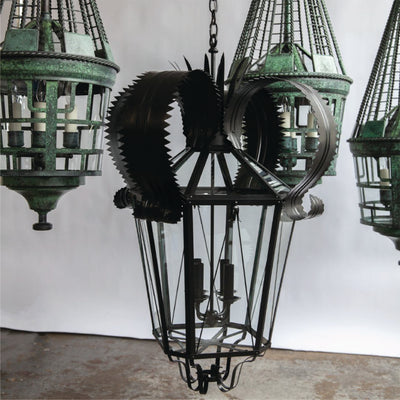
I pressed on and delivered the group to a tour of the 100 year old plant; who doesn’t love a factory tour? Crucibles of molten metal, dudes operating heavy machinery, layers of dust, whoopee! These folks still use ancient, basic sand molding techniques, but also have a sophisticated array of modern tooling as well. They developed the patterns from our computer models, scaled, stretched, and shrunk as needed, cast them in yellow brass and machined all the critical tolerances. The result is that the lights are all quite lovely.

Here’s a few views of their immense pattern library, some dating back to the early days of the 20th Century

The raw castings of our fixtures

The “dry-fit” of the wall mounted version

Everyone left, in spite of their misgivings much impressed, slightly grubbier, and with a souvenir pair of safety glasses.

One of the biggest benefits of using a local vendor is the ability to visit the job in process. That’s a bit more difficult when they are 6000 miles away.

-David Calligeros

Posted in All Posts | Comments Off

Rockland County Courthouse

I used a part of my lunch break while on Jury duty to explore the grounds of the Rockland County Courthouse, a limestone art deco structure dating to 1928.

The main stair hall and foyer to the courtrooms are detailed with bas relief sculpture, painting, and lighting fixtures in carved stone, glass and bronze. The vocabulary of the decorative program is neoclassic crossed with biomorphic art deco; lots of swirly foliate forms in amongst the zigzagging geometry. The top of the stair has two large bronze and glass torchieres on coffee colored marble plinths.

Remains Lighting Rockland County Courthouse Plinth Light

Remains Lighting Rockland County Courthouse Plinth Light Detail

The walls have matching sconces. And the ceiling has a huge gilded and painted zodiac surrounding a river valley (the Hudson presumably) scene, all flanked by eagles holding the scales of justice, surmounting fasces… whew.

Remains Lighting Rockland County Courthouse Sconce art deco

Remains Lighting Rockland County Courthouse Ceiling art deco

I wonder who wrote the sculptor’s brief and what a laundry list of points it contained.

The doors to this area are locked from the main entrance; one accesses the space through the 2nd floor of the 2001 addition. However, if you walk around to the exterior of the main façade, you’re treated to more sculptural metalwork. There are many lovely examples of grillework around the building, both in wrought iron and nickeled bronze, as well the three pairs of double doors on the main façade.

Remains Lighting Rockland County Courthouse Double Doors

These doors have very bold wrought iron work, especially the ribbons in the lower sections, and overlapping wreathes of laurel that climb to the axe-head details in the top panel.

Remains Lighting Rockland County Courthouse Door Detail

This axe-head detail, perhaps an emblem of justice (though that’s just a guess) is repeated in the window guards you can see below the small grille pictured below.

Remains Lighting Rockland County Courthouse Grille Window Guards

The main event, lighting-wise on the exterior are the two massive pier lights on granite bases.  Though these appear to be patinated bronze, the green is simply paint. These are made of cast iron.

Remains Lighting Rockland County Courthouse Exterior Post Lights

The tops are tiered, cascading, waterfalls over the octagonal lantern body. That, along with much scrolling, foliate, icicled, ribbed, and otherwise decorative stuff is supported on four base-and-capital-less fluted columns, and furthermore on an octagonal base supported by four resolute looking turtles.

Remains Lighting Rockland County Courthouse Exterior Post Light Turtle Base

It just so happened that I was walking past the 5th avenue and 42nd St. branch of the New York Public Library late last night and happened to notice the same beasts supporting the flagpole there. Coincidence… conspiracy…? Perhaps there’s some iconographic significance to the turtle (long life? slow pace?)

Remains Lighting New York Public Library Statue Turtle Base

No description of the decorative arts and sculpture of the Rockland County Courthouse would be complete without a mention of the sculpture commissioned for the 1987 rededication of the building (in celebration of the 200th anniversary of the signing of the US constitution.) I met a woman while on jury duty in this building 10 years ago who was commissioned to write a poem for the occasion, which was also enlivened by the unveiling of a new sculpture that was under wraps until the beginning of the ceremony. She described a hush that fell over the crowd when she got on the podium to read her poem and the wraps fell away from the new sculpture. The assembled citizens, town politicos, and various random dignitaries were left publicly applauding the sculpture. I leave it to your own imagination to imagine what they thought of its shape.

Remains Lighting Rockland County Courthouse Sculpture

I only wish it was made of a better material than concrete. It is not aging as well as it might if it was made of one of the classics like limestone, marble, or bronze.

-David Calligeros

Posted in All Posts | Tagged , , | Comments Off

Secret Fishbowl

Alix and I spent a few hours shopping for antiques in Marrakech with Michael Graham and his wife Donna one afternoon. I found my favorite piece of art aside from the architectural details in the houses, museum, and madrassa, was in a small antiques shop in the north end of the medina. The place was full of lovely things, including very cool lighting fixtures, but these took my breath away.

The proprietor had a pair of brass bowls, maybe 16” wide x 10” tall, with very fine damascene work on the exteriors. The age darkened brass was inlayed with copper and silver designs, script, sinuous foliate details, and banding. The quality was superb and a relief from the acres of mid-level stuff on sale elsewhere.

Inside the bowls however, was an unexpected surprise. The inside surface was scored with deep hatching into which was hammered further silver and copper designs, in this case a scene of fish chasing each other around a center rondelle.

This process is known as “kuftgari.” and is different from true damascene work because the hatched ground makes it possible to inlay the silver and copper wires anywhere on that ground, rather than directly into prepared grooves. I was particularly taken by the semi-hidden or private nature of the design.

In the house I grew up in, my mom had (still has) such a bowl, but with a plain interior, that she uses for a fern or paperwhites or what have you. Perhaps I’m just not schooled enough in the use of these objects but to me the form makes sense as a flower bowl or a planter. I suppose these could have been filled with water (and fish?) and the rippling water would set the design to life. Nonetheless, the interior of a metal bowl is not in my experience a place for decoration, certainly not the place for the most interesting of the object’s decoration. Perhaps it has something to do with the Islamic disapproval of representational image making. You could show these to your trusted friends only.

I’m reminded of a set of Chinese cabinets I once saw that upon unlatching of secret latches, revealed panels of erotic scenes.

-David Calligeros

Posted in All Posts, Craftsmanship | Tagged , , | Comments Off

Handmade Metalwork in Marrakech

On my trip to Morocco a few weeks back, I took the opportunity to dig into the design and making of the metal arts. I only had a few hours, so consider this barely scratching the surface. Nonetheless, I found a few interesting and forthcoming people and places to share.

One definitely must ask before photographing people and wares in Marrakech for several reasons: You’ll surely arouse the ardent interest of the shopkeeper, whether you want it or not…. It’s common to pay people to photograph them and you’ll want to know what you’re on the hook for before shooting….You may get a better picture…. And of course to not ask would be rude.

I found one of the metalworkers markets and even managed to have lunch there among the sounds of clanging hammers and shrieking angle grinders… ah sweet music. The shops are full of bonafide local, handcrafted metal things; the most common items being lanterns. There are so many lanterns. The quality of the goods is fair, not excellent, as you might expect from shops set up in 50 square feet that successfully bang out a full range of product.

This engaging young man was applying a brown patina to a light made of steel that he would let rust and then later varnish.  A process not unlike what we might employ in our factory. His colleague was sitting on a low bench curving the blanks, snipping the shapes, and punching out the pierced work designs with a coffee can full of simple chisels. I was impressed by the scope of their work relative to the simplicity of their tools.


Applying the patina


A body of a light raised from a flat sheet by hammering over a steel stake and into a sandbag


The chisels used for punching the pierced-work designs


The work surface used for punching the pierced-work designs

The sharp steel chisels are hammered through the softer sheet metal on an cake of lead that’s supported on a heavy block of steel (think mini-anvil) which is itself supported by a block of wood or a tree trunk.

One of the most interesting aspects of the shops on this square is that they were universal in a way. You could ask for a duct angle for your air conditioner, a tin lantern, a watering can, whatever basic article you might desire done out of sheet metal, and they would make it. While eating our eggplant dip and tomato salad we saw a 8 or 9 year old apprentice hammering away on some part or another while his dad or the shop foreman checked in to assist or comment from time to time.

On a note related to hand craft in general, you still see these primitive bow-lathes used to turn chess-pieces and other small items in the narrow alleys of the souk. The turner moves the bow, with a piece of cord wrapped around the work, back and forth while he holds a gouge-chisel against the work to cut his profile. This tool has been in use since the 10th century in essentially the same, unchanged form.

In another part of town I found an alley of metal polishers and a brass supply house where you could get a bit of banding or a bit of wire. The techniques, sounds, and scent of polishing is the same the world over I think.


On the other side of the quality divide we were lucky enough to see for a minute two gentlemen who were real top artists in their field. They of course take a LOT more time with each piece in design, layout, and execution. The pierced work shade in this case is sawn with a jewelers’ saw, similarly to how we would approach a one-of-a-kind job.

-David Calligeros

Posted in All Posts, Craftsmanship | Tagged , , , | Comments Off

Last of the Neighbor’s Trash

Here’s I think, the last of the rich vein of design related news from that stash of drawings I found last month. There are a set of product designs, most, seemingly related to specific projects, one looks simply like a  design exercise. They’re all drawn in a distinctly 1940s vibe; but a few are clearly beginning to head out of the older streamlined vocabulary.

My favorite from a graphic standpoint is the iron.
iron drawing

This is still deeply under the influence of Art Deco or Moderne, or Streamlined design. The style makes sense as the object is modern technology, albeit domestic.  It’s just a fun composition as well: the chrome and black plastic are shiny, the background glossy yellow, the option for linen, apparent.

The next four images are furniture for hospitality. There’s this one bench that’s particularly labeled for the restaurant powder room for the 30th St. Station in Philadelphia. Who designs a bench for a train station powder room today, let alone one as cool as this, with such a sinuous seat?
Powder Room Bench

The 5/8-round bar stool has an upholstered seat in leather(?) with exposed nail heads.
Bar Stool Design

The side chair has a clean, boxy back.
side chair

The table has the most period specific look of the furniture with its horizontal banded pedestal, domed foot, and glass top.

Oops, I forgot about the groovy speckled armchair and the geometric veneer and white lacquer commode… uh there they are!
arm chair

Commode

These last 2 don’t seem to fit into the above categories, and appear later, style-wise than the others. Perhaps they were related to Jack Colgan’s work at his own firm. The commode in particular seems suited for a residence, rather than a commercial interior.

-David Calligeros 

Posted in All Posts, Architecture | Tagged , , , , | Comments Off

Green Roofs and Other Sustainable Technologies in New York City

I was invited to present to a group of green building professionals, businesses, and community leaders along with a few other speakers, including Congresswoman Nydia Velazquez, yesterday at Pratt Center for Community Development. The focus of the event was green roofs and related green technologies that one could implement in a combined, synergistic fashion.

Adam Friedman of the Pratt Center and Congresswoman Velazquez spoke about what direction policy might take to aid the adoption of green and sustainable technologies. The cost of implementing sustainable technologies, whether they are power or air quality or water conservation related are artificially high relative to the status quo. Because polluting and other “externalities” are not charged to the polluting producer and the consumer who buys their product; they get to directly benefit from cheap production and a cheap purchase price. Those “external” costs are very real however, and are paid by everyone on the planet in as much as our air or water, or earth is degraded. There’s a role for government to play in removing pollution subsidies and in providing an even playing field for sustainable technologies to compete against their pollution-intensive alternates.

Congresswoman Nydia Valazquez speaking at the Pratt Center

I presented the whole building project that Remains implemented on its factory between 2008 and 2010, especially the relation between our green roof, photovoltaic solar panels, and rainwater irrigated gardens. 

Photovoltaic panels at Remains Lighting

Our green roof in bloom

Bill Rigos from Steinway Pianos spoke about his company’s innovative solar thermal system. That was a real boundary pushing project with a novel combination of technologies deployed on a rooftop, perhaps for the first time. You can see his whole presentation here: http://admin.nyirn.org/sites/default/files/users/rnyc/steinway_presentation_solar_thermal.ppt

Mike DiMartino from Linda Tool, a machine shop in Red Hook Brooklyn discussed his company’s green roof project and the intensive monitoring system he installed. The monitoring of the roof over 2 years, including a full weather station yielded, and continues to yield great data on the real benefits of green roofs, especially in terms of temperature control and storm water management, the later a very important, but overlooked issue.

There’s Mike, on his roof.

-David Calligeros


Posted in Sustainability | Tagged , , , , | Comments Off

Jack Colgan, Modern Architect

They really had to know how things fit together, down to the screws.

I dug deeper into the pile of drawings and prints from my former neighbor’s portfolio. It seems like Mr. Colgan worked for a number of years in big offices doing commercial transportation work. There are several beautiful sketches of dining rooms, a theater, lunch counters, and ticket counters. The first thing that struck me (it was the first thing I saw on the first drawing I unfolded) was the vestige of racist segregation in the “colored lunch room” crossed out by hand with the word “omit” written over it. Was this a bold decision to include all races or a crass decision to exclude people of color altogether, never mind give them a segregated lunchroom? The second is the fine level of detail in these works. Fasteners are rendered with threads, washers, drive styles, materials and finishing notes that don’t seem common today in commercial work.

Alcoa Davenport Works (Harrison Abramovitz Architects 45 Rockefeller Plaza) dining room 1946

Alcoa Davenport Works (Harrison Abramovitz Architects 45 Rockefeller Plaza) dining room 1946

Alcoa Davenport Works (Harrison Abramovitz Architects 45 Rockefeller Plaza) theater

Alcoa Davenport Works (Harrison Abramovitz Architects 45 Rockefeller Plaza) theater

Alcoa Davenport Works (Harrison Abramovitz Architects 45 Rockefeller Plaza) title sheet

Alcoa Davenport Works (Harrison Abramovitz Architects 45 Rockefeller Plaza) title sheet

(Union News Company construction dept) Asheville NC Bus Station 1942

(Union News Company construction dept) Asheville NC Bus Station 1942

(Union News Company construction dept) Asheville NC Bus Station ice cream shop and news stand –millwork details 1942

(Union News Company construction dept) Asheville NC Bus Station ice cream shop and news stand –millwork details 1942

(Union News Company construction dept) Asheville NC Bus Station ice cream shop and news stand –signage details 1942

(Union News Company construction dept) Asheville NC Bus Station ice cream shop and news stand –signage details 1942

(Union News Company construction dept)  Union Station Columbus Ohio 1943 *now demolished*

(Union News Company construction dept) Union Station Columbus Ohio 1943 *now demolished*

Union Station, Columbus, Ohio

(Union News Company construction dept)  York PA Pennsylvania RR Station 1943

(Union News Company construction dept) York PA Pennsylvania RR Station 1943

(Lester C Tichy Architect 369 Lexington Ave NYC, NY) Pennsylvania RR North Philadelphia PA –counter screen, signage, ticket office (nitty-gritty mechanical/aesthetic details!) 1945

(Lester C Tichy Architect 369 Lexington Ave NYC, NY) Pennsylvania RR North Philadelphia PA –counter screen, signage, ticket office (nitty-gritty mechanical/aesthetic details!) 1945

(Lester C Tichy Architect 369 Lexington Ave NYC, NY) Pennsylvania RR North Philadelphia PA –counter screen, signage, ticket office (nitty-gritty mechanical/aesthetic details!) 1945

(Lester C Tichy Architect 369 Lexington Ave NYC, NY) Pennsylvania RR North Philadelphia PA –counter screen, signage, ticket office (nitty-gritty mechanical/aesthetic details!) 1945

This reminds me of a cover of Pencil Points from 1946

This reminds me of a cover of Pencil Points from 1946

In addition to the blueprints, he left these original hand sketches, sadly with no notes of the project locations. Perhaps they were just studies.

The last piece of this story is a drawing from Jack Colgan’s own office that he opened in Rockland County NY in the 1950s.

-David Calligeros

Posted in All Posts, Architecture | Tagged , , , , , , , , | Comments Off

Lights of Marrakech

I am in Morocco this week for the Design Leadership Summit, and we created a special mobile guide to showcase the lighting of Marrakech for the occasion.

Lights of Marrakech is my personal and thoroughly non-comprehensive selection of a few great sightings of historic and iconic light fixtures in a capital of Moorish design.

To open the door to this world, you can click through photos and listings on the app which are linked to a live map and an illustrated glossary of lighting-related decorative arts.

The glossary is an ongoing project of mine that strives to contextualize many common and unusual terms from decorative art movements as they relate to lighting and lighting design.

To install the application on your smartphone or tablet, simply scan the QR code below with a barcode scanning application, or visit remains.com/lightsof/marrakech on your smartphone or tablet. You can also view it on your desktop or laptop computer in the latest versions of Chrome, Firefox and Safari.

David Calligeros

Posted in Antique and Vintage Lighting, Architecture | Tagged , , , , | Comments Off